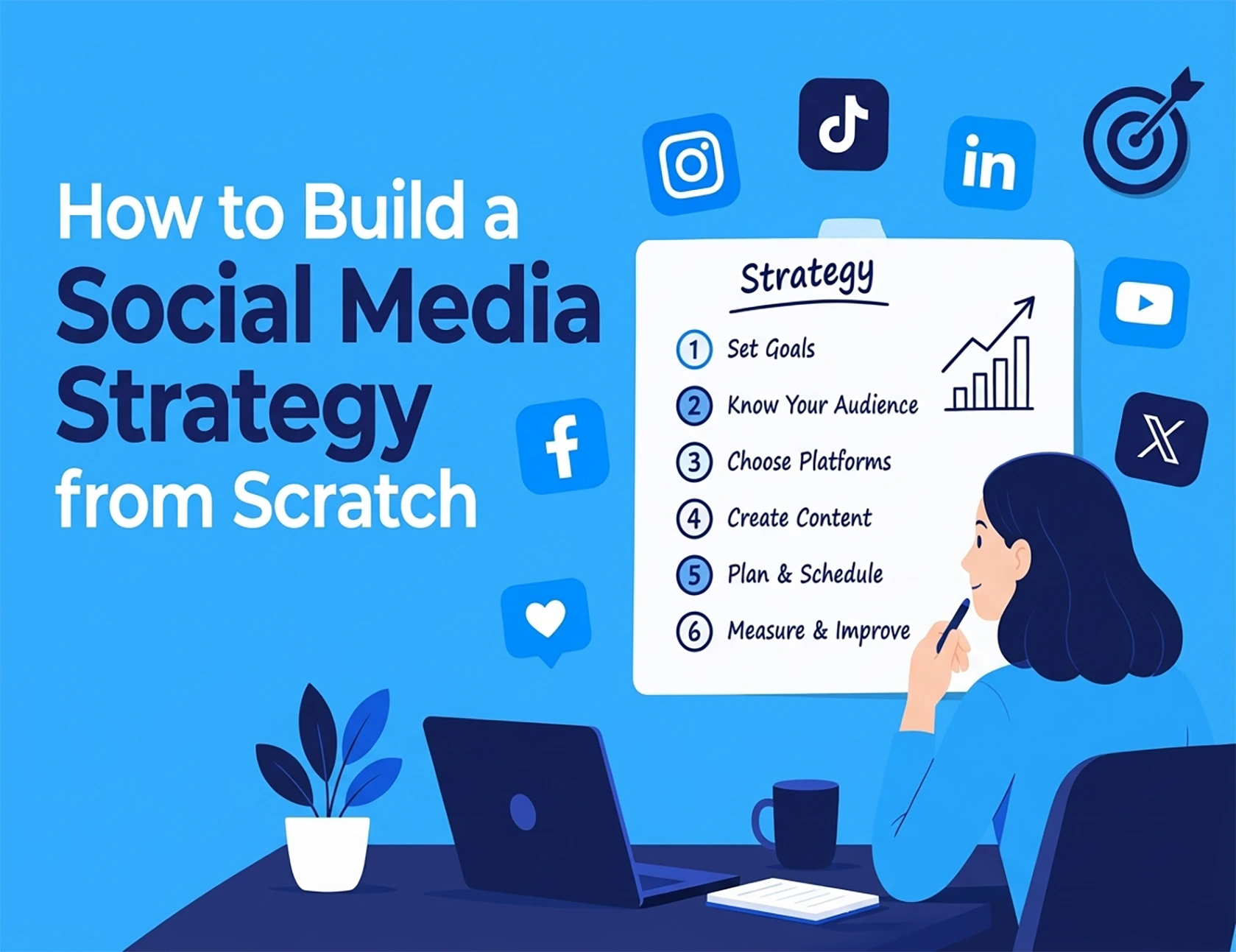
A social media strategy is built by connecting five things: a business goal, a defined audience, a small number of suitable platforms, a repeatable content system, and clear measures of success. Start by deciding what social media needs to achieve, then research who you want to reach, choose the channels where that audience is active, plan useful content, and review the results regularly. Without those decisions, a posting schedule may keep your accounts busy, but it will not necessarily move the business forward.
At 7 Kings Marketing, we build social media strategy from scratch after analyzing your needs, goals, current vision and future vision!
1. Begin with a clear business purpose
The first question is not, “What should we post?” It is, “What should social media help us do?” A company might need to build awareness, generate leads, support customers, introduce a product, recruit employees, or increase online sales. These are different jobs, so they require different content and measures.
Choose one primary objective for the next three months. You can have supporting objectives, but a long list of equal priorities usually produces unfocused content. For example, a small software company might decide that its main goal is to generate qualified demo requests. Its social content can then explain customer problems, show the product in use, answer objections, and direct interested people to a relevant landing page.
This also gives the team a sensible way to reject distractions. A trend may be popular, but if it does not reach the right people or support the current objective, it may not deserve time.
2. Audit your starting point
If you are building a strategy from scratch, “starting point” does not mean you have no information. You may already have social accounts, customers, website data, sales questions, and several months of posts to examine.
List every account your organization owns, including abandoned profiles. Check the profile image, description, contact details, links, pinned content, and recent posts. A new visitor should be able to understand what the organization does and what to do next within a few seconds.
Then review the last 60 to 90 days of content. Note which topics and formats earned meaningful responses, such as saves, shares, comments, clicks, enquiries, or sales. Also record weak posts. Poor results can reveal a mismatch in topic, format, timing, or audience. The audit should create benchmarks, not just a collection of opinions.
3. Research the people you want to reach
A useful audience description is more specific than “people aged 25 to 45.” Demographics can help, but they do not explain why someone would stop scrolling, trust a brand, or take action.
Describe the audience’s problems, goals, buying concerns, language, interests, and online habits. What questions do customers ask before purchasing? What prevents them from acting? Which advice do they already follow? Which platforms do they use for discovery, research, or support?
Use several sources rather than relying on assumptions. Speak with customers and sales staff. Review support requests, website search terms, reviews, comments, polls, and platform analytics. Social listening can also reveal recurring conversations about your category and competitors.
You do not need a complicated set of personas. One or two useful profiles are enough to guide early decisions. Write each profile as a real person with a problem to solve, not as a vague demographic segment. That makes it easier to judge whether a post is genuinely relevant.
4. Turn the objective into measurable goals
A goal such as “get more engagement” is too broad. A stronger goal states what will change, by how much, and by when. This is the logic behind SMART goals: specific, measurable, attainable, relevant, and time-bound.
For example: “Generate 40 qualified consultation enquiries from LinkedIn in the next quarter.” The goal identifies the outcome, channel, number, and time. It can be reviewed and adjusted if the evidence shows that the target or process is unrealistic.
Choose metrics that match the goal. For awareness, reach, impressions, and non-follower reach may be useful. For engagement, look at shares, saves, comments, and meaningful replies. For traffic, track link clicks and click-through rate. For commercial results, track sign-ups, enquiries, purchases, and conversion rate. Follower growth can provide context, but it is rarely the final business result.
Set a baseline before setting a target. Otherwise, the target is likely to be arbitrary and difficult to defend.


5. Choose fewer platforms and give each one a job
You do not need to be active everywhere. Choose the platforms where your audience is present, where your content suits the format, and where your team can maintain a reliable standard. Most new strategies are better served by one or two priority platforms than by five neglected accounts.
Give each chosen channel a simple mission. LinkedIn might build professional credibility and generate business enquiries. Instagram might demonstrate products and develop brand familiarity. YouTube might provide in-depth education and customer support. The choice depends on the audience and the business, not on a universal ranking of platforms.
Optimize each profile with accurate information, relevant keywords, a clear description, and a useful link. Keep the underlying brand message consistent, but do not publish identical content everywhere. Each platform has its own habits, formats, and expectations.
6. Build content around a few reliable pillars
Content pillars are the recurring subjects that organize your publishing. Three to five pillars are usually enough for a new strategy. A home fitness brand, for example, might use beginner education, practical routines, customer stories, product guidance, and behind-the-scenes content.
The pillars should reflect both audience needs and business strengths. If every post is promotional, people have little reason to follow. If every post is entertaining but disconnected from the business, attention may not lead anywhere. A balanced mix can include useful education, evidence or demonstrations, conversations with the audience, company perspective, and selected offers.
Plan the idea first, then adapt it to the channel. A detailed tutorial might become a short video, a carousel, a newsletter link, or a concise professional post. Repurposing saves time, but copying the same caption and format across platforms often feels careless.
Every post does not need a hard call to action. Sometimes the right action is to save the advice, answer a question, share an experience, visit a page, or simply remember the brand. The call to action should fit the purpose of the content.
7. Make the calendar realistic
A content calendar turns the strategy into work that can actually happen. It can be a spreadsheet or a project-management board. Include the date, platform, content pillar, format, working copy, visual requirement, call to action, owner, approval status, and publication link.
Start with a cadence your team can sustain for at least a quarter. Consistency matters more than an ambitious schedule that collapses after two weeks. Leave room for timely posts, but do not let trends replace the planned foundation.
A simple workflow also prevents avoidable problems. Decide who creates, reviews, approves, publishes, and responds. Establish basic rules for brand voice, claims, copyright, customer privacy, and sensitive topics before a problem occurs.
8. Plan for conversation, not only distribution
Publishing is only one part of social media. People may ask for advice, report a problem, challenge a claim, or mention the brand without tagging it. Decide who monitors the accounts and how quickly different types of messages should receive a response.
Not every comment requires the same answer. A straightforward question may need a public reply. A complaint may need acknowledgement followed by a private conversation, without hiding the issue or making promises the company cannot keep. A serious or sensitive matter may need to be escalated to customer service, legal, or a senior manager.
Encourage discussion with specific questions, polls, requests for examples, and customer contributions. Community management is not an extra task after the “real” marketing; it is part of how trust is built.
9. Review the evidence and adjust the strategy
A strategy should provide direction without becoming permanent. Review your core metrics at least monthly, using the same definitions and reporting period. Avoid changing the entire plan because one post performed unusually well or badly.
Look for patterns. Which subjects attract the right audience? Which formats lead to saves, shares, clicks, or enquiries? Are people watching but not acting? Are the best results coming from a particular audience segment or platform? Compare performance with the original goal, not with an unrelated metric.
After a full quarter, decide what to keep, improve, test, or stop. This balance matters: social media needs enough patience for patterns to emerge, but it also needs enough flexibility to respond to evidence. Buffer recommends monthly review and a broader quarterly decision cycle, while other strategy guides similarly emphasize testing and adjustment.
A simple first 30 days
In week one, audit your accounts, interview a few customers, and choose one primary business objective. In week two, define the audience, set a measurable target, and select one or two platforms. In week three, create your content pillars, write several post ideas, and establish the response workflow. In week four, prepare and publish the first batch of content.
Then keep a monthly record of results and audience observations. A workable social media strategy is not a document that sits untouched in a folder. It is a clear set of choices that helps the team decide what to publish, where to focus, and what to change next. Start small, measure honestly, and expand only when the process is producing dependable results.
Sum Up:
Pick one goal. Describe your audience in plain terms. Choose two platforms. Settle on three to five content pillars. Commit to a posting schedule you can keep. Engage with people. Review your numbers monthly.
You don't need a big budget or a large team to start. You need clarity about what you're trying to achieve and the discipline to show up consistently. Your first strategy won't be perfect, and it doesn't have to be. Treat it as a working draft, learn from what happens, and refine it as you go.
If you'd like expert help putting this into action, explore our Social Media Marketing Services to get started.
Leave a Reply
Your email address will not be published. Required fields are marked *